
Research project of Tuba Arshad, M1 Nanochemistry, at the Laboratory of Electrochemistry and Physico-chemistry of Materials and Interfaces (LEPMI) Grenoble.
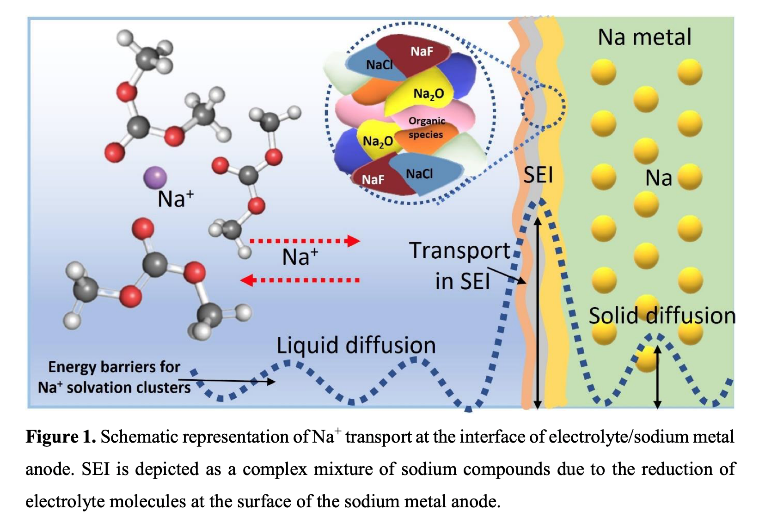
The Li-ion technology is the most developed due to high energy density. However, for a larger scale development, the Li could be limit by the amount of resources on earth. That is why the Na that is 2-3 order magnitude more abundant on earth crust than Li and cells with only abundant element could fit well for worldwide scale development. The battery working is the same, despite replacing the Li+ ion by Na+. The Na, as being an alkali metal as Li present similar physical-chemical properties could profit of the wide knowledge on Li to have a fast development.In this context AMPERE (Renault Group) and LEPMI (Saint Martin d’Hères Campus) collaborate on a project about the development of Na-ion batteries and of the understanding of electrode/electrolyte interphase. Ampere is part of Renault group, a worldwide known car brand that plan to be an European leader on Electric Vehicle with innovative technology. Indeed, this interphase plays a major role on the long-term stability of the cells and power performance, because if unstable it led to a continuous consumption of Na ion that decrease the overall capacity each cycle.
In this project, the student from the Soft Nanoscience Program will investigate the formulation of different electrodes and understand the impact of the electrode formulation on the cell performance. Characterization of the electrochemical performance will be performed by physical-chemical methods to complete the electrochemical data (post-mortem analysis).
Supervision
Academic supervisor: Dr Didier Devaux at LEPMI - UGA
Industrial partner: Adrien Méry (AMPERE, Renault Group)